

As a trainee journalist, I was taught that my book of contacts would become my most valuable asset.
Back then, it was an actual physical notebook with names and numbers scribbled in pen on each page. These were the humans I called upon to help me fill blank pages with stories that were worth money.
Today—years after moving into product marketing—little has changed.
Storytelling is still at the heart of my day-to-day. There’s still a product being sold. And I still rely heavily on my contacts—or, as I call them now, my customers.
Not every product marketer thinks about customers this way. But it makes life so much easier.
Need a speaker for that webinar? You know who to call. Case studies for a launch? Locked in. And when sellers ask questions in training, you’ve got real-world examples to back them up every time.
So what can you do to work this muscle and get it to pay off for you?
In this article, I’ll explain why customer relationships are so important to your success—and what you can do to create and develop them.
The problem with skipping customer interactions
One of the biggest mistakes I see product marketers make is to overlook customer interactions.
I’ve worked with product marketers that joined less than three customer calls in a year. Our leadership didn’t encourage it either. Of course, they were worse at it than any of us.
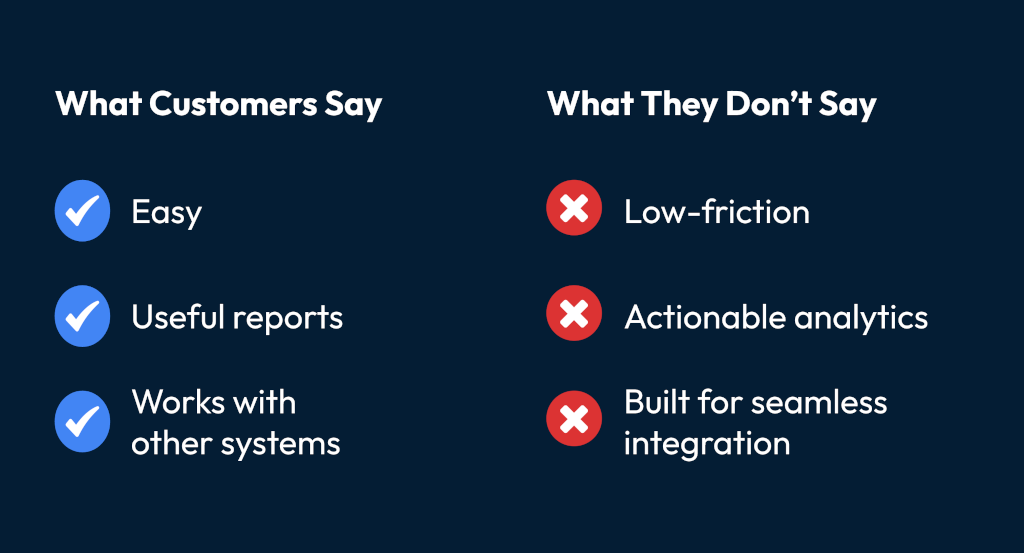
If you ever wondered why vague, buzzwordy messaging is all over SaaS websites, look no further. It’s because PMMs spend more admiring other SaaS content than speaking with their own customers.
It’s why your sales teams switch off during buyer persona presentations. It’s why you don’t get invited to roadmapping sessions.
Really, some of the biggest offenders of this in the product marketing world are the same people wanting a “seat at the table”. It fascinates me that they don’t realize how little they have to offer any such table.
The benefits of making time for customers
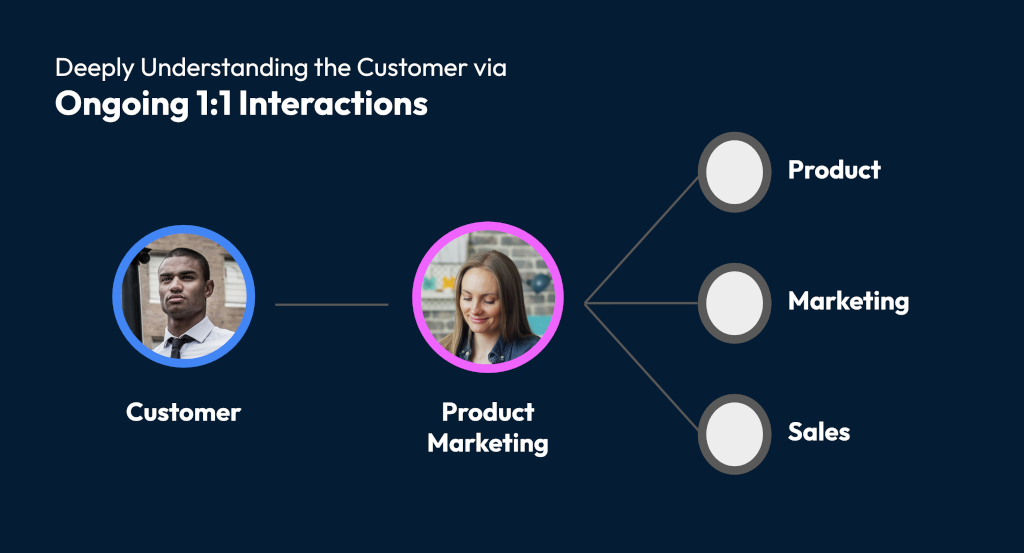
All PMMs should, in my opinion, strive for at least one live customer interaction per week. It doesn’t have to be a direct interview set up by you, but it should be a scenario in which you have the opportunity to ask questions and get feedback.
While this does require an investment of time, here’s why building rapport with customers is worth it:
- Messaging effectiveness. Customer conversations give you the chance to test different messaging and positioning. You can be super direct—ask if your stance or choice of words resonates with them. Also pay attention to how they speak. What words do they use? How do they think? Can you spot any patterns? Start building a voice-of-customer (VOC) database that you can share with other members of your marketing team.
- More engaging sales presentations. Throwing anecdotes from customer conversations into presentations to your sales team will make them listen. Suddenly, you have something to offer that you got from the people who matter. Buyer personas, competitive teardowns, positioning guides, and customer use cases will become more trustworthy since it’s clear you did your research.
- Marketing participation. When you build rapport with customers, they’re more likely to participate in case studies, webinars, and conference appearances. A customer quote to support your launch content is just a call or text away. This makes your content so much stronger. When you don’t know who to ask, on the other hand, this process is always awkward and stressful.
- Roadmap input. PMMs help shape the product roadmap—but too often, we rely on secondhand feedback from internal teams. Direct customer conversations let you spot real patterns, challenge internal assumptions, and prioritize features that will actually drive adoption. When you’re in roadmap meetings, you won’t just be repeating sales requests—you’ll bring first-hand insights that make the difference between a “nice-to-have” feature and a game-changer.
- Professional credibility. Product marketers are supposed to be SMEs in their company’s customers, but most fail to reach that status in reality. That means you can stand out by investing some more energy here. Not only will you be recognized internally as a more valuable contributor, but you’re also more likely to be given promotions, big projects, media engagements, and other highly-visible career-boosting opportunities.
How to interact with customers as a PMM
While the above benefits sound great, I know some PMMs believe it’s not realistic to interact directly with customers regularly. Some even argue it’s not their job.
Often the objections come as questions like:
- But how do I make time for this when I’m already spinning so many plates?
- How do I convince the customer, who is also busy, that they should talk to me?
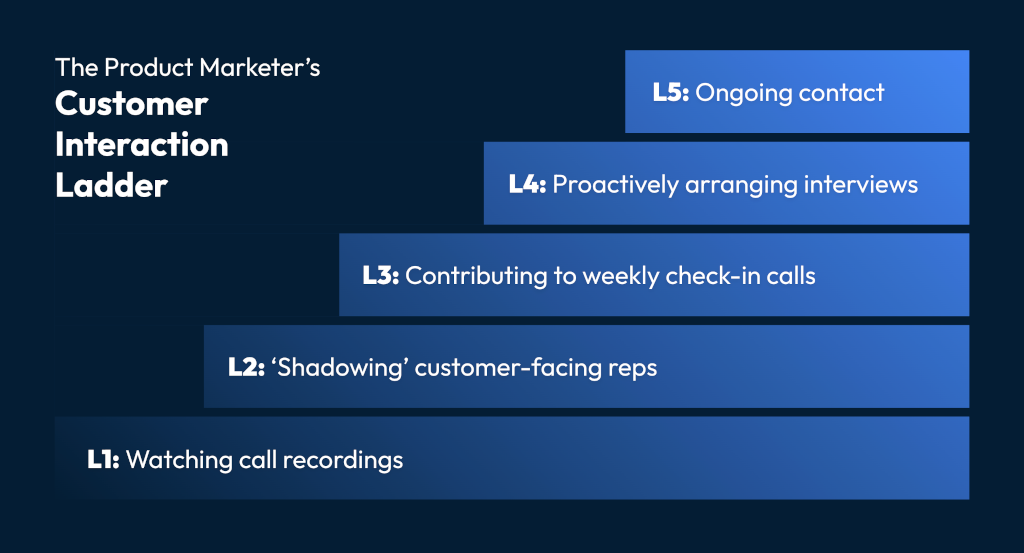
- Can’t I just watch call recordings to get the same information?
These are all valid and important questions. So let’s look at some simple, practical ways to set up time with customers—and make that time as useful as possible.
Join routine check-in calls
To set up interactions with minimal burden on the customer, you can simply join existing calls they have with account managers or CSMs. Join the call as a “product expert” and offer to give the customer a personal demo of a new feature that’s being tested, or some input into the product roadmap. I don’t think I’ve ever experienced this being badly received by a customer. Usually, it makes them feel important and they are happy to share feedback.
Offer to support AEs with their deals
While it can be annoying to be asked at short notice to whip up presentation decks for account executives, it’s actually an opportunity to lean into a deal and get more involved. Offer to work with the prospect to build a business case for their executives. If you can offer support in a way that requires multiple touchpoints, you can build rapport with the customer that way and also learn a ton about the sales motion.
Set up win/loss interviews
Finding out directly from the customer exactly why they did or didn’t buy your software is one of the most valuable interactions you can have. You’d be surprised how open people are to this interaction, even if they chose another vendor. I used to think this was an audacious request—like, why would they talk to me? But I discovered customers acknowledge the value of their feedback in strengthening the market overall. And if they had a good experience with your sales rep, they often feel like giving feedback is the decent thing to do.
Connect with customers on social media
Much like salespeople do, you should feel free to connect with customers on LinkedIn and celebrate their achievements or engage with their posts. This keeps you fresh in their minds and helps to maintain a personal connection.
Let them contact you on their terms
It’s super important not to just hammer customers with requests for things you need. The art of building relationships is being generous with what you offer and not expecting or demanding anything back. As a PMM, you have valuable knowledge to share on how your product works and how other customers are using it. Offer to take questions or feedback from the customer whenever they need it, as they start using a new feature. The key here is that they are now contacting you on their terms. This earns you some “credit” to use later when you need something from them.
Action steps to become a more customer-centric PMM
The best product marketers don’t just write about customers—they know them. They don’t just collect secondhand insights from sales or product teams—they get firsthand knowledge that shapes messaging, launches, and roadmap decisions.
If you’re not regularly talking to customers yet, now’s the time to start. Block out 30 minutes on your calendar right now to join a customer call, or reach out to an AE for an introduction.
It doesn’t need to be perfect—just start somewhere.
Here’s what to do next:
- Find an easy win. Check your calendar or ask your CSM team: “Are there any customer calls I can sit in on this week?”
- Prepare just one great question. You don’t need a full interview script—just one question that helps you learn more about their pain points. (Example: “What’s been the most frustrating part of [X] for you lately?”)
- Take notes and look for patterns. Start a simple document to track common phrases, frustrations, and reactions. The more you do this, the sharper your messaging and content will become.
Commit to this weekly, and in a few months, you won’t just be a better PMM—you’ll be the person sales, product, and leadership turn to when they need to know what customers actually care about.

